BIG LEAP General Assembly drives progress on second-life battery systems
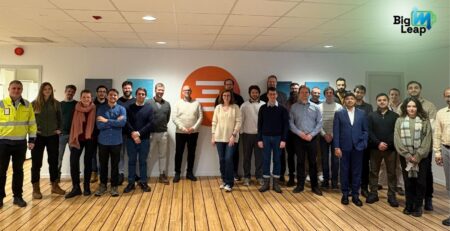
Bigleap2026-07-08T10:20:36+00:00The BIG LEAP consortium gathered on 17-18 June 2026 at VTT premises in Espoo, Finland, for its 5th General Assembly, marking a key moment as the project moves closer to large-scale validation.
Over two intensive days, partners aligned on technical progress, coordinated upcoming activities, and reinforced a shared direction towards real-world deployment of second-life battery systems.
From development to demonstration
A central focus of the meeting was the progress of the project’s three demonstration activities, designed to validate BIG LEAP solutions under realistic operating conditions.
As the project advances, attention is increasingly shifting from development to testing. Discussions covered system integration, validation strategies, and the preparation of test environments across different use cases.
Key areas of work included:
- Integration of battery management system (BMS) functionalities
- Preparation of testing protocols and validation scenarios
- Alignment of system architectures across demonstration sites
This phase is critical to ensure that second-life batteries can operate reliably within complex energy systems.
Strengthening technical alignment
The General Assembly also provided a space to synchronise progress across multiple technical work packages. Ongoing work focuses on connecting system components, data flows, and software layers to enable consistent validation across the project.
Partners are advancing in:
- Structuring data for analysis and validation
- Enhancing interoperability between devices and platforms
- Refining testing procedures for battery performance and system behaviour
Digital tools, including data platforms and system-level models, are playing a key role in supporting this integration and enabling more accurate evaluation of results.
Moving towards validation
As BIG LEAP progresses, coordination becomes increasingly important. The consortium reviewed overall progress and aligned on next steps to ensure that activities remain consistent across technical areas.
The transition into validation requires not only technical readiness, but also clear methodologies and shared definitions of performance and success. This alignment ensures that results can be reliably compared and contribute to a coherent evaluation of second-life battery systems.
Building the foundation for scalable solutions
The outcomes of the General Assembly highlight a clear direction: BIG LEAP is entering a phase where solutions are tested, refined, and prepared for real-world application.
By combining demonstration activities, digital tools, and coordinated validation strategies, the project is building the foundations for energy storage systems that are more flexible, resource-efficient, and aligned with circular economy principles.
Second-life batteries are not only a technical opportunity. They are a pathway towards more sustainable and adaptable energy systems.